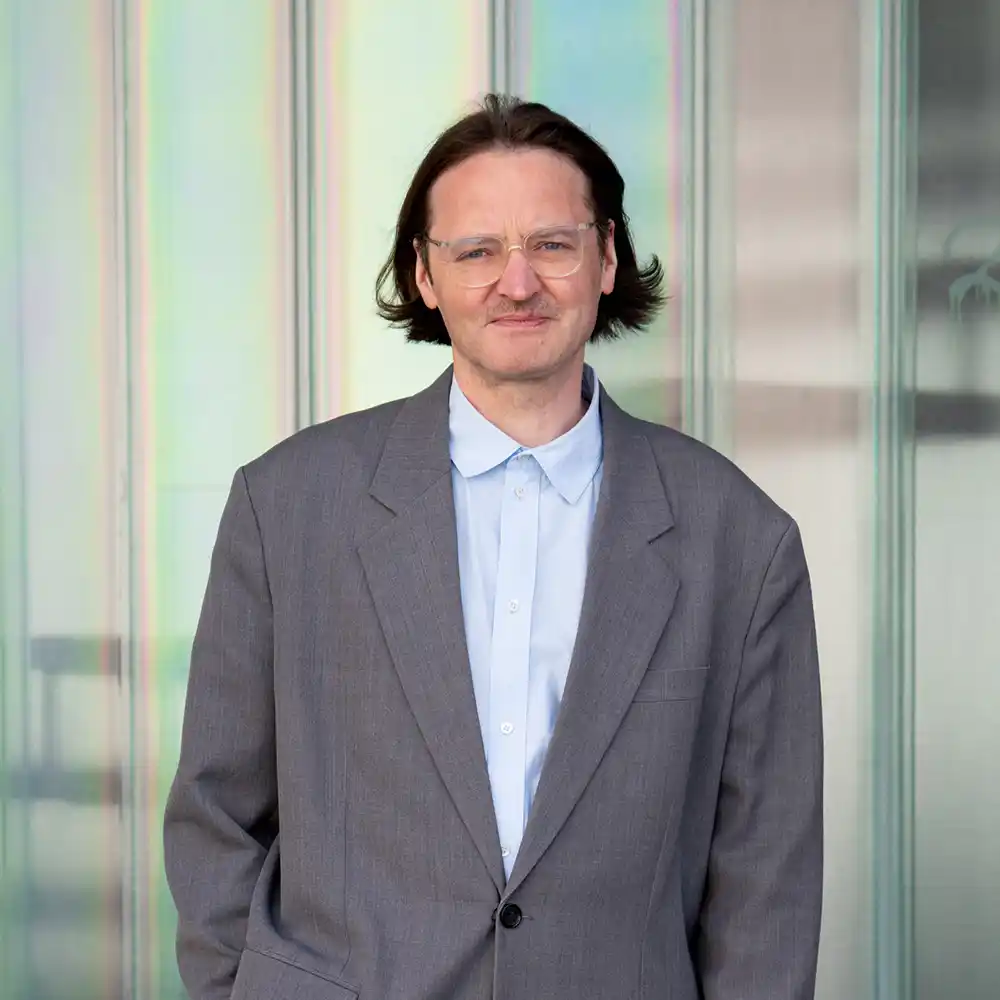
Photo: Tautvydas Stukas
Valentinas Klimašauskas
Director CAC, Contemporary Art Centre, Vilnius
Biography
Valentinas Klimašauskas (b. 1977, Lithuania) is a curator, writer, and director of the Contemporary Art Centre, Vilnius since January 2025.
Recently, he curated the 1st Klaipėda biennial, the Lithuanian pavilion at the Venice Biennial 2024 (with João Laia, artists: Pakui Hardware and Marija Teresė Rožanskaitė). Together with João Laia Valentinas curated “The Endless Frontier,” the 14th Baltic Triennial at CAC Vilnius (2021). With Inga Lāce, they curated “Saules Suns,” a solo exhibition by Daiga Grantina for the Latvian Pavilion at the Venice Biennale (2019).
Other recently curated projects include “Ocean Eyes,” the Coast Contemporary festival in Lofuotta/Láfot/Lofoten Islands (2023); “Today, yesterday, tomorrow,“ a non-commercial part of the ArtVilnius’23; “nEYEYEght” at Galeria Francisco Fino, Lisbon (2023); “Fluid bodies,” a series of 5 exhibitions at Nemuno 7, Zapyškis (2022); “An Incomplete & Unreliable Guide to Social Media War Room” as part of the “Curated by” festival at Georg Kargl Gallery, Vienna (2021) and “The sex lives of fruit flies” at Low gallery, Riga (2021).
Klimašauskas is the author of “Telebodies. Bleeding Subtitles for Postrobotic Scenes” (Mousse Publishing, 2024), “Polygon” (Six Chairs Books, 2018), “Oh, My Darling & Other Rants” (The Baltic Notebooks of Anthony Blunt, 2018), and “B” (Torpedo Press, 2014).
More of Klimašauskas writings could be found at: https://selectedletters.lt
Abstract
Regarding generosity as an institutional methodology
Against the backdrop of increasing societal division and polarisation, the policy of programming also includes examining the various strategies to build relationships.
The title “Inventing the Friend” refers to the critical anti-ideological essay “Inventing the Enemy” by Italian philosopher and writer Umberto Eco. According to Eco, having an enemy is essential not only in defining our identity, but also in offering us a problem against which we can evaluate our value system and, in seeking to solve it, demonstrate our worth. So when there is no enemy, we must invent one.
Today, there is no shortage of enemies or antagonists in either political life or the art system, but the internal reconciliation that an external enemy usually offers is also absent. Why did this happen?
Modernist art, which was extended by contemporary art, never promised to be friendly to visitors. However, today this relationship has undergone a change. “Making (art) enemies” out of the bourgeoisie, and so on, have transformed into new strategies for befriending.
Today, most museums offer opportunities for so-called museum buddies, friends, and other memberships, striving to be as inclusive as possible to their visitors, often paying for it with the populist price of diluting or vulgarising art. Given these dangers, how one is balancing between establishing multiple and ambiguous relationships or criticizing them – is the creation of the other, a relationship with the other, still necessary, or is the positive creation of the self through the other as a friend possible, and if so, is this not one of the functions of contemporary art? And what about now? What forces can force us to build relationships against the backdrop of multiple crises and wars? Why would we skip the exhibition today? How can we, despite everything, make friends?
